
Does Maintaining Pulp Vitality Offer Value for Money?*
Oral disease remains a significant global public health concern, affecting more than 3.7 billion people worldwide.1 The economic burden is staggering, with a recent study estimating the global cost of oral conditions at $710bn USD in 2019.2 Only 54.5% ($387bn) of this was attributed to direct costs of treatment, highlighting the often-underestimated indirect costs associated with loss of productivity.2
The most prevalent non-communicable disease worldwide, dental caries alone is thought to account for 5-10% of healthcare budgets in industrialised nations.3 This is against a backdrop of unprecedented financial strain on healthcare systems in countries like the United Kingdom, where it was announced in 2024 that the NHS dentistry budget had experienced real-terms cuts of £1bn since 2010.4
When dental need is increasing but resources are plummeting, there is enormous pressure on dental professionals to demonstrate value for money in their clinical practice. In this article, we invite world-leading experts in dental health economics to explain how treatments like vital pulp therapy with BiodentineTM can help.
Why dental professionals must be able to demonstrate value
The primary obligation of a dental professional must always be to strive for the best clinical outcomes for the patient. However, this must be weighed against the needs and limitations of the payer, whether that is a healthcare system, an insurer, or the patient themselves. In order to find an optimal balance between the two, it’s becoming increasingly important for dental professionals to develop strong literacy in the economics of dental health.
Prof. Dr. Falk Schwendicke, Professor and Director of the Clinic for Conservative Dentistry and Pedodontology at Ludwig Maximilian University, says: “At the end of the day, the practice is an economic entity, and we need to be able to show patients, insurers, and funders that what we do is worthwhile, not just clinically but economically.”
The economics of saving the pulp
In recent years, dental professionals have begun to shift away from procedures like root canal treatment and pulpectomy in favour of more conservative and minimally invasive approaches geared towards preserving tooth vitality. One such approach is vital pulp therapy (VPT).
VPT is a collection of techniques aimed at protecting vital pulp and facilitating healing in cases of deep carious lesions or accidental pulp exposure.
VPT preserves the developmental, defensive and proprioceptive functions of the pulp tissue and helps to keep patients out of what Prof. Dr. Schwendicke refers to as the ‘death spiral’ of increasingly invasive treatments.5 It’s also considered technically easier to perform than root canal or pulpectomy treatments. But does saving the pulp have economic benefits as well as clinical benefits?
Despite the millions of dollars presumably spent in the field – the American Association of Endodontists (AAE) reports that 41,000 root canals are performed every day in the United States, with the average endodontist performing 25 per week6 – Dr Schwendicke says that research into the economics of endodontic interventions is sparse compared to fields like cariology and periodontology. That’s something Dr Schwendicke has been working to change.
What the research says
Back in 2013, Prof. Dr. Schwendicke and colleagues created a decision model on the treatment of deep caries lesions.7 Decision models are mathematical models designed to mimic real-world scenarios and outcomes based on the synthesis of all available clinical data. While clinical trials can tell us about immediate outcomes, decision modelling can help us to map the full lifetime of an intervention, with all of its potential outcomes and their costs, to understand the optimal pathway of care.
In Prof. Dr. Schwendicke’s 2013 decision model, the research team compared the long-term cost-effectiveness of non-selective caries removal (referred to as ‘complete’ in the research), selective (‘incomplete’) one-step removal, and selective two-step removal.
The model showed that one-step selective removal was by far the most cost-effective intervention, and also the most successful in maintaining pulp vitality and retaining the tooth. According to Prof. Dr. Schwendicke, this shows that keeping invasiveness to a minimum early on has a big impact on long-term cost-effectiveness and clinical outcomes.
Building on this research in 2014, Prof. Dr. Schwendicke and Dr. Michael Stolpe used decision modelling to compare the most cost-effective intervention when the pulp was exposed: direct pulp capping or root canal treatment.8 This is an important question for endodontists because teeth treated with direct pulp capping do sometimes go on to require root canal treatment. When the root canal could have been performed immediately, with potentially better outcomes, the use of direct pulp capping must be justified.
The model showed that despite requiring follow-up treatment earlier than teeth treated with a root canal, those treated with direct pulp capping were retained for a longer period of 52 years. This was achieved at a significantly lower lifetime cost of €545, compared to €701 for teeth treated with root canal.
When the pulp cannot be saved, the economics of treatment become less clear-cut. A 2024 decision model study compared the cost-effectiveness of pulpotomy vs root canal treatment in teeth with irreversible pulpitis, finding that root canal treatment was the more expensive – but more successful – treatment option.9
In this case, cost-effectiveness came down to willingness to pay. When the payer was prepared to spend less money, pulpotomy was considered the most cost-effective over the patient lifetime. But if the payer was prepared to pay more for the root canal, the long-term benefits were considered to be worth the initial higher cost investment.
Broadly speaking, the research shows that the earlier we intervene with pulp-preserving measures like selective caries removal and VPT, the more cost-effective and clinically beneficial they are compared to root canal treatment. As the patient gets further along the treatment path, however, trade-offs must be made in order to achieve value.
Dr Schwendicke says: “It comes back to this ‘death spiral.’ The more invasive we get with endodontics, the harder the economic balances get. The endodontic interventions get more expensive and at some point, it gets harder and harder to justify retaining the tooth. The balance can easily tilt to the point where, for example, an implant actually becomes the cost-effective choice. Maintaining the pulp can keep us out of the spiral altogether.”
How BiodentineTM helps clinicians to deliver value
BiodentineTM is a hydraulic calcium silicate cement that is particularly well-suited for use in vital pulp therapies. Although BiodentineTM was not part of this specific study, it offers practitioners a lower upfront cost than MTA – without compromising on clinical effectiveness. In fact, BiodentineTM has completely reshaped the field of restorative dentistry with dual therapeutic and restorative properties way beyond those achieved by MTA. It has demonstrated a success rate of 95.8% for indirect pulp capping10, 96.4% for direct pulp capping11, and 93.9% for pulpotomy.12 Here’s how BiodentineTM has been helping both general dentists and endodontic specialists to deliver better value for money while maintaining pulp vitality.
Superior dentine remineralisation and pulp healing14
The ESE recommends hydraulic calcium silicate cements like BiodentineTM over other materials, such as glass ionomer cement (GIC), for direct placement over the pulp thanks to its superior ability to promote pulp healing and remineralise carious dentine.13-16
BiodentineTM preserves pulp vitality by stimulating the pulp’s own natural healing capabilities.14 Unlike other tricalcium silicate materials that are based on Portland cement and often contain toxic trace elements from manufacturing, BiodentineTM is made with proprietary Active Biosilicate TechnologyTM to guarantee a material of the utmost purity.17,18 It therefore has no cytotoxic, mutagenic, sensitising, or irritant effects on exposed pulp, ensuring high cell viability and enhancing biological healing.14
BiodentineTM has been shown to support increased mineral deposition in the dentine, leading to the formation of thicker, denser layers of tertiary dentine compared to GIC, MTA and CH.19-22 Although GIC and BiodentineTM have both been shown to remineralise caries-affected (firm) dentine, only BiodentineTM was able to significantly remineralise caries-infected (soft) dentine.23 By preserving more natural dentine, BiodentineTM supports a more minimally invasive – and therefore cost-effective – approach.
Excellent sealing ability and antibacterial properties14
Obtaining a tight seal and preventing bacterial infiltration are critical to the success and longevity of any vital pulp treatment.
BiodentineTM achieves superior adhesion to the dentine surface by creating mineral tags into the openings of the dentinal tubules17, forming a tight interface, a firm bond, and a good seal.14 Biodentine™ demonstrates superior marginal sealing and adaptation, establishing itself as the most effective dentin substitute under composite resin when compared to MTA and GIC. Its placement beneath the composite resin reduces polymerization shrinkage, enhancing the overall integrity of the restoration.24
Of course, by leaving behind carious dentine, as per the selective removal technique, it is understood that bacteria will also be left behind. However, the high alkaline pH of BiodentineTM is highly unfavourable for bacterial proliferation, effectively disinfecting the carious dentine once placed.14,25
The strength and hardness of natural dentine
In order for the pulp to heal, it is important that the chosen material is strong enough to protect it from occlusal forces. BiodentineTM is very similar to natural dentine in microhardness and compressive strength, and is superior to GIC in both.17 In the posterior teeth, where the occlusal forces are greatest, BiodentineTM has proven to be a reliable temporary enamel restoration to allow for pulp healing for up to six months.26 In addition, its unique physiomechanical properties make it suitable for use as a permanent dentine substitute under final composite restoration.
Streamlined procedures
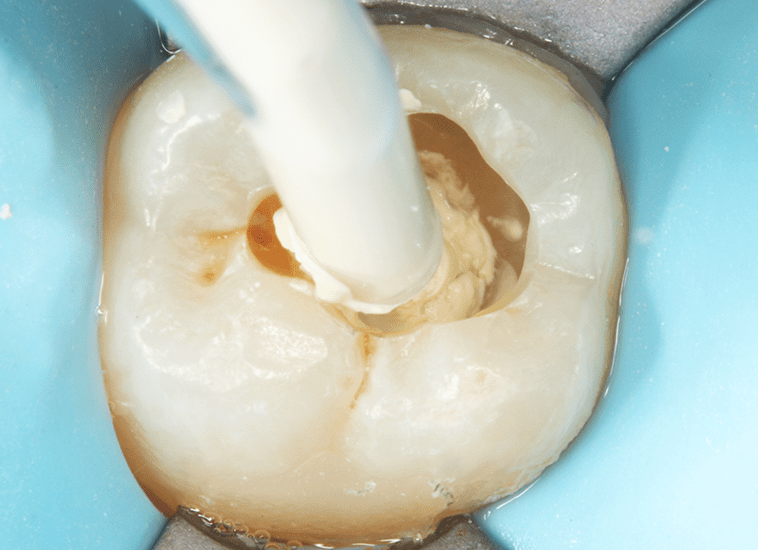
In addition to remarkable clinical outcomes, BiodentineTM can improve cost-effectiveness in the practice by simplifying procedures and streamlining workflows. It can be used in one-step cavity filling from pulp to crown in the Bio-Bulk Fill procedure, even when the pulp is exposed, and it can be covered with a final restoration in the same session. With no need for second visits and re-entry, that means fewer appointments and less time in the chair.
BiodentineTM and VPT: The perfect partners for economic restorative dentistry
Although he hopes to see even more research on the cost-effectiveness of vital pulp therapies, Prof. Dr. Schwendicke says that the evidence so far is clear: “Maintaining pulp vitality is cost-effective and preferable to root canal treatment. Saving the pulp is not only clinically valid, it’s also economically valid.” With over 1,500 published studies* and counting demonstrating its clinical benefits, it’s clear that BiodentineTM is the suitable material to help dentists and endodontists to achieve this. As it becomes increasingly important for endodontics to prove its value to funders, insurers and the patients themselves, saving the pulp with BiodentineTM is a clinically and economically smart decision for every practitioner.
*Publications available at https://pubmed.ncbi.nlm.nih.gov/
References
1. World Health Organization (WHO). Global oral health status report: Towards universal health coverage for oral health by 2030. https://www.who.int/team/noncommunicable-diseases/global-status-report-on-oral-health-2022. Published 18 November 2022
2. Heidelberg University Hospital. Oral diseases cost the world $710 billion annually. Newsroom. https://www.klinikum.uni-heidelberg.de/newsroom/en/oral-diseases-cost-the-world-710-billion-annually/. Published November 14, 2024.
3. European Federation of Periodontology (EFP). White paper: Oral health in comprehensive health – The EFP’s manifesto. EFP. https://www.efp.org/fileadmin/uploads/efp/Documents/Other_publications/EIxEFP_-_Oral_Health_white_paper_FINAL.pdf.”
4. British Dental Association (BDA). A billion in cuts. BDA News and Opinion. https://www.bda.org/news-and-opinion/news/a-billion-in-cuts/. Published January 25, 2024.
5. Bjørndal L, Simon S, Tomson PL, Duncan HF. Management of deep caries and the exposed pulp. Int Endod J. 2019 Jul;52(7):949-973. doi: 10.1111/iej.13128. Epub 2019 May 13.
6. American Association of Endodontists (AAE). (n.d.). Press kit. https://newsroom.aae.org/press-kit/.
7. Schwendicke F, Stolpe M, Meyer-Lueckel H, Paris S, Dörfer CE. Cost-effectiveness of one- and two-step incomplete and complete excavations. J Dent Res. 2013 Oct;92(10):880-7. doi: 10.1177/0022034513500792. Available at: https://pubmed.ncbi.nlm.nih.gov/23945975/
8. Schwendicke F, Stolpe M. Direct pulp capping after a carious exposure versus root canal treatment: a cost-effectiveness analysis. J Endod. 2014 Nov;40(11):1764-70. doi: 10.1016/j.joen.2014.07.028. Available at: https://pubmed.ncbi.nlm.nih.gov/25218524/
9. Naved N, Umer F, Khowaja AR. Irreversible pulpitis in mature permanent teeth: a cost-effectiveness analysis of pulpotomy versus root canal treatment. BMC Oral Health. 2024 Feb 28;24(1):285. doi: 10.1186/s12903-024-04052-9.
10. Kaul S, Kumar A, Jasrotia A, Gorkha K, Kumari S, Jeri SY. Comparative Analysis of Biodentine, Calcium Hydroxide, and 2% Chlorhexidine with Resin-modified Glass Ionomer Cement as Indirect Pulp Capping Materials in Young Permanent Molars. J Contemp Dent Pract. 2021 May 1;22(5):511-516. Available at: https://pubmed.ncbi.nlm.nih.gov/34318769/
11. Parinyaprom N, Nirunsittirat A, Chuveera P, Na Lampang S, Srisuwan T, Sastraruji T, Bua-On P, Simprasert S, Khoipanich I, Sutharaphan T, Theppimarn S, Ue-Srichai N, Tangtrakooljaroen W, Chompu-Inwai P. Outcomes of Direct Pulp Capping by Using Either ProRoot Mineral Trioxide Aggregate or Biodentine in Permanent Teeth with Carious Pulp Exposure in 6- to 18-Year-Old Patients: A Randomized Controlled Trial. J Endod. 2018 Mar;44(3):341-348. doi: 10.1016/j.joen.2017.10.012. Available at: https://pubmed.ncbi.nlm.nih.gov/29275850/
12. Guang J, Li J, Hao L. Clinical observation and histopathological evaluation of pulp after pulpotomy of primary teeth with formocresol and biodentine. Cell Mol Biol (Noisy-le-grand). 2022 May 31;68(5):83-88. doi: 10.14715/cmb/2022.68.5.11. Available at: https://pubmed.ncbi.nlm.nih.gov/36029512/
13. European Society of Endodontology (ESE) developed by:; Duncan HF, Galler KM, Tomson PL, Simon S, El-Karim I, Kundzina R, Krastl G, Dammaschke T, Fransson H, Markvart M, Zehnder M, Bjørndal L. European Society of Endodontology position statement: Management of deep caries and the exposed pulp. Int Endod J. 2019 Jul;52(7):923-934. Available at: https://onlinelibrary.wiley.com/action/showCitFormats?doi=10.1111%2Fiej.13080
14. About I, ed. Biodentine™ Properties and Clinical Applications. Springer. 2022.
15. Watson TF, Atmeh AR, Sajini S, Cook RJ, Festy F. Present and future of glass-ionomers and calcium-silicate cements as bioactive materials in dentistry: biophotonics-based interfacial analyses in health and disease. Dent Mater. 2014 Jan;30(1):50-61. doi: 10.1016/j.dental.2013.08.202. Available at: https://www.sciencedirect.com/science/article/pii/S0109564113004004
16. Kuru E, Eronat N, Türkün M, Çoğulu D. Comparison of remineralization ability of tricalcium silicate and of glass ionomer cement on residual dentin: an in vitro study. BMC Oral Health. 2024 Jun 26;24(1):732. doi: 10.1186/s12903-024-04475-4. Available at: https://pubmed.ncbi.nlm.nih.gov/38926776/
17. Internal data: Biodentine™ Scientific File, 2011 – specific pages.
18. Rajasekharan S, Martens LC, Cauwels RGEC, Anthonappa RP. Biodentine™ material characteristics and clinical applications: a 3 year literature review and update. Eur Arch Paediatr Dent. 2018 Feb;19(1):1-22. doi: 10.1007/s40368-018-0328-x. Avaimable at: https://pubmed.ncbi.nlm.nih.gov/29372451/
19. Selvendran KE, Ahamed AS, Krishnamurthy M, Kumar VN, Raju VG. Comparison of three different materials used for indirect pulp capping in permanent molars: An in vivo study. J Conserv Dent. 2022 Jan-Feb;25(1):68-71. doi: 10.4103/jcd.jcd_551_21. Available at: https://pmc.ncbi.nlm.nih.gov/articles/PMC9200191/
20. Boddeda KR, Rani CR, V Vanga NR, Chandrabhatla SK. Comparative evaluation of biodentine, 2% chlorhexidine with RMGIC and calcium hydroxide as indirect pulp capping materials in primary molars: An in vivo study. Journal of the Indian Society of Pedodontics and Preventive Dentistry. 2019 Jan-Mar;37(1):60-66. DOI: 10.4103/jisppd.jisppd_213_17. Available at: https://europepmc.org/article/med/30804309
21. Chauhan A, Dua P, Saini S, Mangla R, Butail A, Ahluwalia S. In vivo Outcomes of Indirect Pulp Treatment in Primary Posterior Teeth: 6 Months’ Follow-up. Contemp Clin Dent. 2018 Jun;9(Suppl 1):S69-S73. doi: 10.4103/ccd.ccd_48_18. Available at: https://pmc.ncbi.nlm.nih.gov/articles/PMC6006903/
22. Hashem D, Mannocci F, Patel S, Manoharan A, Brown JE, Watson TF, Banerjee A. Clinical and radiographic assessment of the efficacy of calcium silicate indirect pulp capping: a randomized controlled clinical trial. J Dent Res. 2015 Apr;94(4):562-8. doi: 10.1177/0022034515571415. Available at: https://pmc.ncbi.nlm.nih.gov/articles/PMC4485218/#section10-0022034515571415
23. Shara Sajini, Amre R. Atmeh, Avijit Banerjee, Frederic Festy, Richard J. Cook, Manoharan Andiappan, Timothy F. Watson. ‘Glass-ionomer and calcium silicate-based cements interactions with human dentine in health and disease: Two-photon fluorescence microscopy and Raman spectroscopy analysis’. Dental Materials. 2022, 38(11): 1710-1720. ISSN 0109-5641. Available at: https://doi.org/10.1016/j.dental.2022.09.001
24. Niranjan B, Shashikiran ND, Singla S et al. A comparative microleakage evaluation of three different base materials in Class I cavity in deciduous molars in sandwich technique using dye penetration and dentin surface interface by scanning electron microscope. J Indian Soc Pedod Prev Dent. 2016; 34(4): 324-30. Available at: https://pubmed.ncbi.nlm.nih.gov/27681395/
25. Kaur M, Singh H, Dhillon JS, Batra M, Saini M. MTA versus Biodentine: Review of Literature with a Comparative Analysis. J Clin Diagn Res. 2017 Aug;11(8):ZG01-ZG05. doi: 10.7860/JCDR/2017/25840.10374. Available at: https://pmc.ncbi.nlm.nih.gov/articles/PMC5620936/
26. Koubi G, Colon P, Franquin JC, Hartmann A, Richard G, Faure MO, Lambert G. Clinical evaluation of the performance and safety of a new dentine substitute, Biodentine, in the restoration of posterior teeth – a prospective study. Clin Oral Investig. 2013 Jan;17(1):243-9. doi: 10.1007/s00784-012-0701-9. Available at: https://pmc.ncbi.nlm.nih.gov/articles/PMC3536989/
* Disclaimer: The views, opinions, and statements expressed in this content are solely those of Dr Falk Schwendicke. Dr Schwendicke is solely responsible for the scientific and medical positions presented.
Sign up now and get an exclusive access to: